
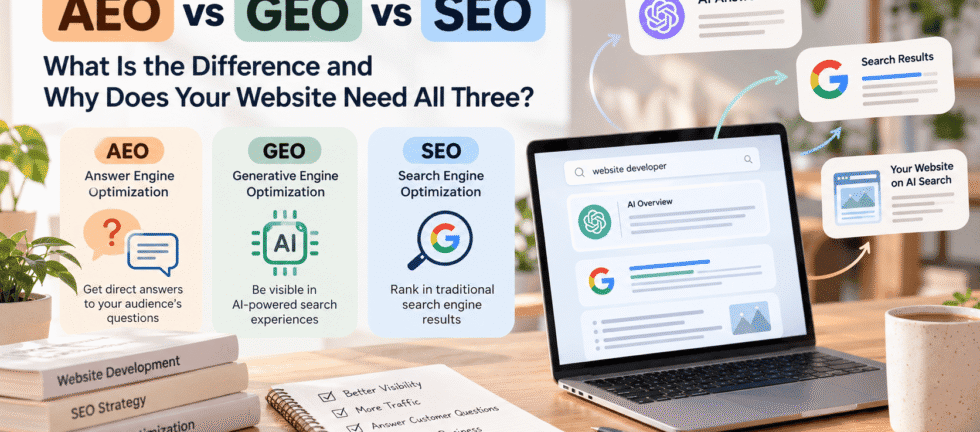
AEO vs GEO vs SEO: What Is the Difference and Why Does Your Website Need All Three?
Search is changing. People no longer rely only on Google to find information, compare services, or choose a website developer. They also ask AI-powered tools questions and use conversational search experiences to explore their options.
For businesses, this creates an important opportunity: making their websites easier to discover through traditional search engines, answer engines, and AI-powered search experiences.
But what is the difference between SEO, AEO, and GEO? Do you need separate strategies for each, or can one well-planned approach support all three?
In this guide, we will explain how these approaches work, why they matter, and how to apply them to your website.
What Is SEO (Search Engine Optimization)?
Search Engine Optimization (SEO) is the process of improving a website so that search engines can discover, understand, and potentially show its pages to people searching for relevant information.
SEO includes several important areas:
- Technical SEO: Making sure your website can be crawled and indexed, with a clear structure and no avoidable technical barriers.
- On-page SEO: Optimizing page titles, headings, URLs, internal links, and relevant content.
- Content SEO: Publishing useful information that answers your audience’s questions and matches their search intent.
- User experience: Making your website fast, mobile-friendly, accessible, and easy to navigate.
- Authority and reputation: Building credibility through useful work, genuine customer experiences, and relevant references across the web.
For example, if someone searches for “Shopify developer for a small business”, a well-optimized service page may have an opportunity to appear in relevant search results.
SEO remains the foundation of a strong search visibility strategy. Search engines and AI-powered search features still rely on discoverable, relevant information to help people find answers.
What Is AEO (Answer Engine Optimization)?
Answer Engine Optimization (AEO) focuses on making website content useful and easy to understand when people are looking for direct answers to specific questions.
Instead of targeting only broad keywords, AEO encourages you to answer the questions your audience actually asks.
Examples include:
- How much does a WordPress website cost?
- How long does Shopify website development take?
- Why is my website not appearing on Google?
- What is the difference between Shopify and WordPress?
AEO-friendly content often includes:
- Clear answers near the beginning of a relevant section.
- Descriptive headings written around real questions.
- Step-by-step instructions where appropriate.
- Definitions, comparisons, and examples.
- FAQs that address genuine follow-up questions.
For example, a blog about website speed could directly answer “Why is website speed important?” before explaining the technical details.
Important: AEO does not guarantee featured snippets or AI-generated answers. The goal is to provide clear, accurate information that genuinely helps readers.
What Is GEO (Generative Engine Optimization)?
Generative Engine Optimization (GEO) refers to efforts to improve the likelihood that your content is discovered, understood, or referenced by AI-powered search and answer experiences.
These experiences may synthesize information from multiple sources to respond to a user’s question. Depending on the platform and query, they may also provide links to websites used as supporting sources.
For example, a business owner might ask an AI tool:
“What should I look for when hiring a Shopify developer for my online store?”
A useful article that explains the selection criteria, common mistakes, and practical considerations may be relevant to that question.
To support GEO, focus on:
- Publishing original, helpful content rather than rewriting generic information.
- Demonstrating real experience through case studies and practical examples.
- Using clear headings and logically organized information.
- Supporting factual claims with trustworthy sources.
- Keeping business details, services, and portfolio information consistent.
- Making important page content accessible to search engines.
GEO is an evolving area. No specific tactic can guarantee that an AI platform will mention your business or cite your website.
SEO vs AEO vs GEO: What Is the Difference?
| Area | Main focus | Example |
|---|---|---|
| SEO | Visibility in traditional search results | Ranking opportunities for “WordPress developer” |
| AEO | Clear answers to specific questions | Answering “How long does a WordPress website take to build?” |
| GEO | Visibility within AI-generated responses | Helping relevant AI search experiences discover useful information from your website |
These approaches overlap considerably. They are not three completely separate systems, and you do not necessarily need three different content strategies.
A well-structured, technically accessible website with original, useful content can support traditional search visibility and provide a strong foundation for answer-focused and AI-oriented discovery.
What Is AIO (AI Optimization)?
AIO can mean Artificial Intelligence Optimization, although the term is used differently across the digital marketing industry.
In a website visibility context, it generally refers to improving content and digital information so that AI-powered systems can interpret and use it effectively.
Depending on the context, AIO may overlap with GEO, AEO, content optimization, and broader AI search visibility.
For website owners, the practical priorities remain straightforward:
- Explain your services clearly.
- Publish accurate and useful information.
- Organize content logically.
- Maintain a technically accessible website.
- Demonstrate genuine expertise.
- Keep important information up to date.
Rather than treating AIO as a separate technical requirement, consider it part of a broader strategy for making your website useful to both people and the systems that help them find information.
Why Does Your Website Need a Combined Strategy?
Your potential customers use different methods to research products and services. Some browse Google search results, some look for direct answers, and others explore AI-powered tools.
A combined strategy helps you build a website that serves these different information needs.
1. Improve Your Search Visibility
Strong technical SEO and useful content help search engines discover and understand your pages. This is the starting point for building sustainable organic visibility.
2. Answer Customer Questions Clearly
When your content addresses real questions, visitors can understand your expertise and find the information they need without unnecessary effort.
3. Build Trust and Credibility
Detailed service pages, genuine testimonials, original case studies, and accurate information help potential customers assess whether your services are right for them.
4. Reach People at Different Stages of Their Decision
Someone searching “What is Shopify SEO?” may be researching a topic. Someone searching “hire a Shopify SEO specialist” may be closer to choosing a provider.
Create useful content for both audiences and connect relevant articles to your service pages.
5. Support Long-Term Digital Growth
Search interfaces will continue to evolve. Investing in a technically sound website, clear information, original expertise, and a positive user experience gives your business a solid foundation as discovery methods change.
How to Optimize Your Website for SEO, AEO, and GEO
You do not need to rebuild your website from scratch. Start by improving the foundations and then work through these steps.
Step 1: Fix Technical SEO Issues
Check that important pages can be crawled and indexed. Review your XML sitemap, robots.txt rules, canonical tags, redirects, mobile usability, and page performance.
Use Google Search Console to identify indexing problems and understand how people discover your website.
Step 2: Create Helpful, Question-Focused Content
Research the questions your ideal customers ask before hiring a developer or SEO specialist.
For example, you could publish articles about:
- Shopify vs WordPress: Which Is Better for Your Business?
- How to Improve WordPress Website Speed
- Why Is My Website Not Showing on Google?
- What Does a Shopify Developer Do?
- How Much Does Website Development Cost?
Give each article a clear purpose and provide a genuinely useful answer.
Step 3: Structure Your Content Clearly
Use one descriptive H1 heading, logical H2 and H3 headings, short paragraphs, and lists where they improve readability.
Answer the main question early, then explain the details with examples and practical recommendations.
You do not need to make every paragraph extremely short or follow a fixed word count for AI systems. Write for the reader first.
Step 4: Demonstrate Real Experience
Generic articles are easy to find. Your own experience can make a page more useful and distinctive.
As a website developer, you can share:
- Problems you encountered during a real project.
- How you approached a technical issue.
- Before-and-after website improvements.
- Lessons learned from client collaborations.
- Practical website maintenance and SEO recommendations.
Only share client information, screenshots, and results that you have permission to publish. Support performance claims with real evidence.
Step 5: Strengthen Internal Linking
Connect related blog posts to relevant service pages and other helpful articles.
For example, an article about Shopify SEO can link to your Shopify development service page. A WordPress troubleshooting guide can link to your WordPress development or website maintenance service.
Use descriptive anchor text so readers understand what they will find after clicking.
Step 6: Use Structured Data Appropriately
Structured data can help search engines understand certain types of page information and may make pages eligible for supported rich results.
Depending on your content, relevant options may include Article, Breadcrumb, Organization, or Person markup. Use only schema that accurately represents the visible content on your website.
There is no special schema markup that guarantees inclusion in AI-generated answers. Google also does not require special AI files or a separate AI schema to appear in its AI search features.
Step 7: Build a Credible Online Presence
Keep your website’s service information, portfolio, professional profiles, and business details accurate and consistent.
Show genuine client feedback and relevant project experience. Seek legitimate references and links by publishing work that people actually find useful.
Avoid buying fake mentions or publishing large volumes of low-value pages in an attempt to manipulate AI visibility.
Step 8: Measure and Improve
Track your progress using Google Search Console and your website analytics platform.
Monitor relevant search queries, impressions, clicks, indexed pages, organic traffic, and enquiries. Where available, review reporting for generative AI search features.
Use these observations to improve content that is relevant to your business, rather than focusing only on rankings or publishing more articles.
Common AEO and GEO Mistakes to Avoid
Some popular recommendations are presented as guaranteed shortcuts, but they should be approached carefully.
- Publishing AI-generated articles without adding value: Content should be accurate, useful, original, and reviewed appropriately.
- Adding FAQs to every page unnecessarily: Include questions only when they help your audience.
- Adding schema that does not match the page: Structured data should accurately represent visible content.
- Creating special AI files because you expect a ranking boost: Google says files such as
llms.txtare not required for inclusion in its search AI features. - Chasing mentions without building credibility: Genuine expertise and useful information are more valuable than artificial mentions.
- Expecting guaranteed AI citations: No ethical SEO professional can guarantee that a specific AI system will mention or cite a website.
The best approach is to focus on quality, technical accessibility, and the needs of your intended audience.
Frequently Asked Questions
Is SEO still important for AI search?
Yes. Google states that its AI search features use the same foundational SEO practices, including crawlability, indexability, helpful content, and good page experience. Meeting these requirements does not guarantee inclusion.
Is AEO different from SEO?
AEO places particular emphasis on answering users’ questions clearly. SEO is broader and includes technical accessibility, content relevance, site structure, and other factors that support search visibility. The two approaches overlap.
Is GEO a replacement for SEO?
No. GEO is a term for efforts to improve visibility in generative AI experiences. Strong SEO fundamentals remain important, and there is no guaranteed formula for being cited by AI systems.
Does FAQ schema improve AI visibility?
FAQ content can help readers find answers, but FAQ schema does not guarantee AI citations or enhanced search results. Structured data should be used accurately and according to supported search features.
How long does it take to see results?
There is no fixed timeline. Results depend on factors such as your website’s current condition, competition, content quality, crawlability, and how people search for your services. Monitor performance over time and improve pages based on evidence.
Can a small business compete in AI search?
A small business can publish valuable, focused content that demonstrates first-hand expertise and directly addresses its customers’ needs. Visibility is never guaranteed, but useful information and a sound website provide a stronger foundation than generic content.
Final Thoughts
SEO, AEO, and GEO are best understood as overlapping approaches to helping people discover useful information. AIO is another broad term used for AI-oriented optimization, rather than a universally defined separate ranking system.
For your business, focus on a technically sound website, helpful content, genuine client experience, clear service pages, and meaningful internal links. These improvements can support your visibility across traditional and evolving search experiences without relying on shortcuts.
Need help improving your website’s search visibility? Explore my Shopify development, WordPress development, and SEO services to find the right support for your business.