
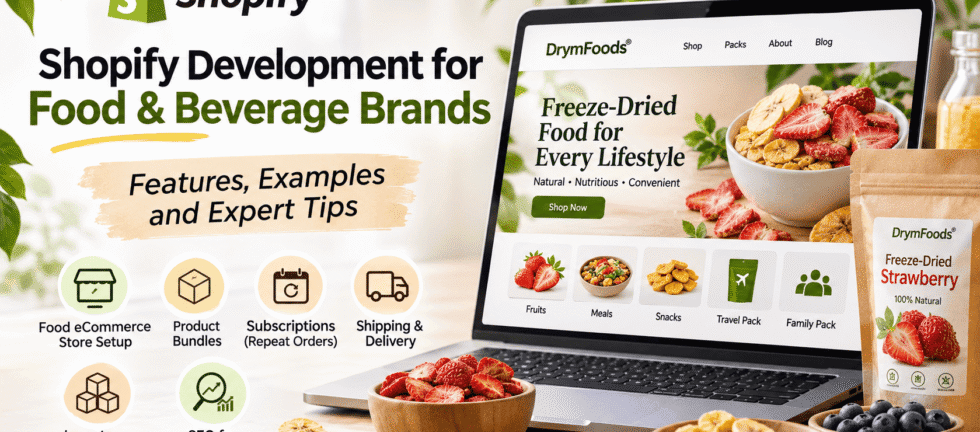
The food and beverage industry is growing rapidly in the eCommerce space. From healthy snacks and organic foods to freeze-dried meals, specialty ingredients, beverages, and packaged food products, more businesses are building online stores to reach customers directly.
However, selling food products online requires more than simply uploading product images and adding prices. Customers need clear product information, convenient shopping options, reliable delivery, secure checkout, and a smooth mobile shopping experience.
This is where professional Shopify development for food and beverage brands can make a difference.
Shopify provides flexible eCommerce tools that help food businesses manage products, collections, orders, payments, and customer experiences. With the right store structure and functionality, brands can build an online shopping experience that supports their products and business requirements.
In this guide, we will explore the essential features of a successful Shopify food store, common eCommerce challenges, practical development tips, and a real-world food website project example.
What Is Shopify Development for Food and Beverage Brands?
Shopify development for food and beverage brands involves building, customizing, and optimizing an online store to meet the specific requirements of food businesses.
Unlike a basic retail website, a food eCommerce store may need detailed product information, ingredient lists, allergen information, nutritional details, product bundles, subscriptions, delivery configurations, and inventory management.
A Shopify developer can help configure these features based on the business model and customer requirements.
Shopify can support different types of food businesses, including:
- Healthy snack and organic food brands
- Freeze-dried food businesses
- Packaged food companies
- Coffee and beverage brands
- Specialty food stores
- Meal kit businesses
- Superfood and nutrition brands
- Subscription-based food businesses
The right website structure depends on the products being sold, target customers, fulfilment process, and delivery locations.
Why Do Food Businesses Choose Shopify?
Shopify is a popular eCommerce platform because it combines store management, product administration, order processing, payment integrations, and customizable themes.
For food and beverage businesses, some useful advantages include:
1. Easy Product Management
Businesses can organize products, variants, collections, pricing, and inventory through the Shopify admin dashboard.
This is useful for brands offering multiple flavours, packaging sizes, product types, and variety packs.
2. Flexible Store Design
Shopify themes can be customized to reflect a brand’s identity, product categories, and customer expectations.
Food brands can use attractive product photography, clear product descriptions, and organized layouts to make product discovery easier.
3. App Integrations
Shopify supports applications for subscriptions, product bundles, customer reviews, shipping, inventory, and marketing.
Businesses can select applications based on their actual requirements.
4. Business Growth and Scalability
A Shopify store can be improved as the business grows. New products, collections, integrations, and features can be introduced as requirements change.
10 Essential Shopify Features for Food and Beverage Websites
1. Clear and Informative Product Pages
Product pages are one of the most important parts of a food eCommerce website.
Customers often want to understand what they are buying before placing an order. Food product pages should provide clear, accurate, and easy-to-read information.
Important product page elements include:
- High-quality product images
- Descriptive product titles
- Unique product descriptions
- Ingredients and nutritional information, where applicable
- Allergen information
- Available product sizes and variants
- Storage and usage instructions
- Shelf-life information, where relevant
- Shipping and delivery details
- Genuine customer reviews
For example, a healthy snack brand can organize product information into sections such as ingredients, nutritional values, product details, and serving suggestions.
This makes it easier for customers to understand the product and make informed purchasing decisions.
2. Organized Product Collections
A well-structured collection system helps customers navigate a food store without confusion.
Instead of displaying all products on one page, businesses can organize them into relevant categories.
Examples include:
- Healthy Snacks
- Organic Foods
- Freeze-Dried Foods
- Beverages
- Breakfast Products
- Family Packs
- Starter Packs
- Variety Packs
- Best Sellers
- New Arrivals
Collection pages should have descriptive headings, useful product filters where appropriate, and clear navigation.
A good collection structure also helps search engines understand the relationship between products and categories.
3. Product Bundles and Variety Packs
Product bundles are particularly useful for food and beverage businesses.
A brand can combine different products into one package and offer customers a convenient way to explore multiple products.
Examples include:
- Starter Packs
- Family Packs
- Travel Packs
- Variety Packs
- Discovery Boxes
- Best Seller Bundles
Shopify merchants can explore Shopify Bundles or compatible third-party applications, depending on the required functionality.
A developer can help configure product selection, bundle presentation, pricing, inventory behaviour, and product page layouts.
4. Subscription Functionality for Repeat Purchases
Some food products are purchased regularly, making subscription options useful for certain businesses.
Examples include coffee, healthy snacks, packaged food, and pantry essentials.
A subscription setup may allow customers to select recurring delivery frequencies such as every two weeks or every month.
Shopify merchants can explore Shopify Subscriptions and other compatible subscription applications.
Before implementation, businesses should check recurring billing requirements, payment provider compatibility, subscription management, cancellation options, and applicable terms.
5. Shipping and Delivery Configuration
Shipping is an important part of food eCommerce operations.
Depending on the products and fulfilment model, businesses may need:
- Standard and express shipping
- Local delivery
- Location-based shipping rates
- Delivery area restrictions
- Minimum order values
- Multiple fulfilment locations
- Temperature-sensitive delivery arrangements
- Order tracking and delivery notifications
Food businesses selling across different regions should carefully review delivery availability, shipping restrictions, packaging requirements, and applicable regulations.
The Shopify shipping configuration should reflect the actual fulfilment process.
6. Inventory Management Across Multiple Locations
Some food businesses operate from multiple warehouses, stores, or fulfilment centres.
These businesses need a reliable way to manage stock availability and order fulfilment.
Shopify supports inventory tracking across multiple locations.
Depending on the business requirements, additional integrations may be needed for:
- External inventory systems
- Warehouse management
- Multi-location fulfilment
- Stock synchronization
- Order routing
- Low-stock notifications
Correct inventory configuration can help reduce stock-related order issues and improve operational efficiency.
7. Mobile-Friendly Shopping Experience
Many customers browse and purchase food products using smartphones.
A mobile-friendly food store should make it easy to browse collections, view product details, select variants, add items to the cart, and complete checkout.
Important mobile improvements include:
- Responsive page layouts
- Readable product information
- Clear navigation
- Easy-to-use buttons
- Optimized product images
- Simple cart experience
- Convenient checkout
Mobile usability should be tested across different screen sizes before launching a store.
8. Website Speed and Image Optimization
Food brands often depend on attractive product photography to present their products.
However, large images, unnecessary applications, excessive scripts, and poorly optimized themes can affect website performance.
Useful optimization practices include:
- Compressing product images
- Using modern formats such as WebP
- Reviewing unused Shopify apps
- Reducing unnecessary scripts
- Using optimized theme sections
- Monitoring Core Web Vitals
- Testing mobile performance
The objective is to maintain good visual quality while providing a fast and convenient shopping experience.
9. Trust-Building Elements
Customers buying food products online often want confidence in the brand and product quality.
A food eCommerce website should provide:
- Genuine customer reviews
- Clear contact information
- Transparent shipping policies
- Refund and return policies
- Secure payment options
- Accurate product information
- Brand story and business details
- Frequently asked questions
Applicable ingredient, allergen, nutritional, and regulatory information should also be displayed accurately.
10. SEO and Search-Friendly Website Structure
A food eCommerce website needs a clear structure so customers and search engines can understand its products and categories.
Important Shopify SEO activities include:
- Keyword research
- SEO-friendly page titles
- Unique meta descriptions
- Descriptive product content
- Optimized collection pages
- Image alt text
- Internal linking
- Sitemap and indexing checks
- Appropriate structured data
- Mobile performance improvements
Regular blog publishing can also help food businesses answer customer questions and attract relevant organic traffic.
Real-World Project Case Study: DrymFoods
Shopify Website Development for a Freeze-Dried Food Brand
Project: DrymFoods
Website: https://drymfoods.com/
Industry: Food and eCommerce
DrymFoods is a food brand focused on freeze-dried food products. The project involved developing and improving its online store to create a more organized product presentation and a convenient shopping experience.
Understanding the Business Requirements
Food eCommerce websites need a clear product structure because customers may want to explore different product categories, compare packs, and understand available options before purchasing.
For DrymFoods, the website experience needed to focus on product presentation, collection organization, and a clear visual identity.
Key Website Development Areas
The project focused on important areas of the online store, including:
Product Presentation
Creating a clearer way to display food products and communicate product information.
Product Collections
Organizing products into relevant categories to make browsing easier.
Product Pack Structure
Planning product pack options such as Starter Pack, Travel Pack, and Family Pack to help customers understand different purchasing options.
Website Design and Layout
Working on the website’s visual structure and product hierarchy to support a more consistent brand experience.
Shopping Experience
Improving the way customers navigate the website and explore available products.
What This Project Demonstrates
The DrymFoods project highlights the importance of combining eCommerce development with thoughtful product organization and user experience.
For food brands, an effective online store should make it easy for customers to discover products, understand product options, and move through the shopping journey.
Explore the project: https://drymfoods.com/
Note: The project description above focuses on the development areas described. Add only the features and work that you personally completed. Avoid publishing unverified sales or conversion claims.
How to Choose the Right Shopify Developer for Your Food Business
Choosing a Shopify developer is an important decision when building or improving an online store.
Before hiring a developer, consider the following:
Review Previous Projects
Look for relevant experience with Shopify stores, product pages, collections, theme customization, and eCommerce integrations.
Understand Their Technical Skills
Depending on your requirements, useful skills may include Shopify Liquid, HTML, CSS, JavaScript, theme architecture, app integrations, and technical SEO.
Discuss Your Business Requirements
Explain your products, target customers, delivery model, inventory process, and required features before starting development.
Ask About Project Scope and Pricing
Discuss the number of pages, required functionality, third-party applications, estimated timeline, revisions, and post-launch support.
Check Communication and Maintenance Support
A good development process requires clear communication, realistic timelines, testing, and a plan for ongoing website improvements.
Common Shopify Mistakes Food Brands Should Avoid
Food businesses should pay attention to these common eCommerce issues:
- Using unclear product descriptions.
- Missing ingredient or allergen information.
- Poorly organized product collections.
- Installing too many unnecessary Shopify apps.
- Incorrect shipping and delivery settings.
- Not testing mobile checkout.
- Using large, unoptimized product images.
- Ignoring inventory management.
- Not reviewing SEO and indexing.
- Failing to test the website before launch.
Identifying these issues early can help create a better online shopping experience.
Frequently Asked Questions
Is Shopify suitable for food and beverage businesses?
Yes. Shopify can support food and beverage businesses selling packaged foods, healthy snacks, beverages, organic products, and other eligible food items. Product collections, bundles, subscriptions, shipping, and inventory features can be configured according to business needs.
Can I sell food products online using Shopify?
Yes. Businesses can use Shopify to sell eligible food products online. They should ensure that product labelling, packaging, storage, shipping, and food safety requirements comply with the regulations applicable to their markets.
Can Shopify support food product subscriptions?
Yes. Shopify merchants can use compatible subscription applications to offer recurring orders. Available functionality depends on the subscription app, payment provider, and store configuration.
Can I create product bundles for my food store?
Yes. Food brands can offer starter packs, family packs, variety packs, and discovery boxes using suitable Shopify bundle functionality.
Can Shopify manage inventory across multiple locations?
Yes. Shopify supports inventory tracking across multiple locations. Businesses with more complex fulfilment or warehouse requirements may need additional applications or integrations.
How can I improve SEO for my Shopify food store?
Optimize product descriptions, collection pages, page titles, meta descriptions, image alt text, internal links, and website performance. Publish useful content that answers customer questions and monitor indexing through Google Search Console.
Do I need a Shopify developer for my food eCommerce website?
A developer may be useful when you need theme customization, custom sections, product bundles, subscription functionality, shipping configuration, app integrations, technical SEO, or ongoing store maintenance. Basic Shopify stores can sometimes be set up without custom development.
How much does Shopify development cost for a food business?
The cost depends on the design, number of pages, custom functionality, applications, shipping requirements, inventory setup, and integrations. Request a project estimate based on your actual requirements rather than relying on a single standard price.
Final Thoughts: Build a Better Online Store for Your Food Brand
A successful food and beverage eCommerce website combines attractive product presentation with practical functionality.
From product pages and collections to bundles, subscriptions, shipping, inventory management, mobile optimization, and SEO, every part of the store should support a convenient customer experience.
Shopify offers flexible tools for food businesses, but the right store structure and configuration are important for making the platform work effectively.
Whether you are launching a new food brand or improving an existing Shopify store, professional development support can help you identify the right solutions for your business.
Need Shopify Development Support for Your Food Business?
I am a freelance Shopify and WordPress developer helping businesses build, customize, and improve their eCommerce websites.
My services include:
- Shopify store development
- Shopify theme customization
- Product and collection setup
- Shopify app integrations
- Product bundles and subscription configuration
- Shipping and inventory setup
- Website improvements and maintenance
- Technical SEO support
If you are planning to launch or improve your food and beverage eCommerce website, I would be happy to discuss your project requirements.
Explore my Shopify Development Services:
Visit my website:
Get in touch to discuss your Shopify development project.